


Building Confidence: Strengthening School Management Committees in Jharkhand, India
Background: a chairperson struggling without guidance
Sunil Tudu, a 40-year-old resident of Khoro village and father of five, was nominated as the Chairperson of the School Management Committee (SMC) in 2024 during the Aam Sabha (village-level general meeting).
Despite his commitment to balancing family responsibilities and his SMC role, Sunil lacked proper orientation on the committee’s roles. This made it difficult to confidently carry out his duties, plan effectively, guide discussions, or speak publicly during meetings.
The challenge: an inactive and hesitant committee
The SMC itself faced significant challenges:
- No prior training had been provided to members.
- Meetings were irregular and participation was low.
- Members were hesitant or silent, unsure of their roles.
Without clarity on responsibilities, the SMC struggled to function effectively or make collective decisions to improve the school. These challenges highlighted the urgent need for capacity building, enabling leaders like Sunil to gain confidence and guiding the SMC toward meaningful engagement.
Intervention: capacity building under the community empowerment project
Training program and approach
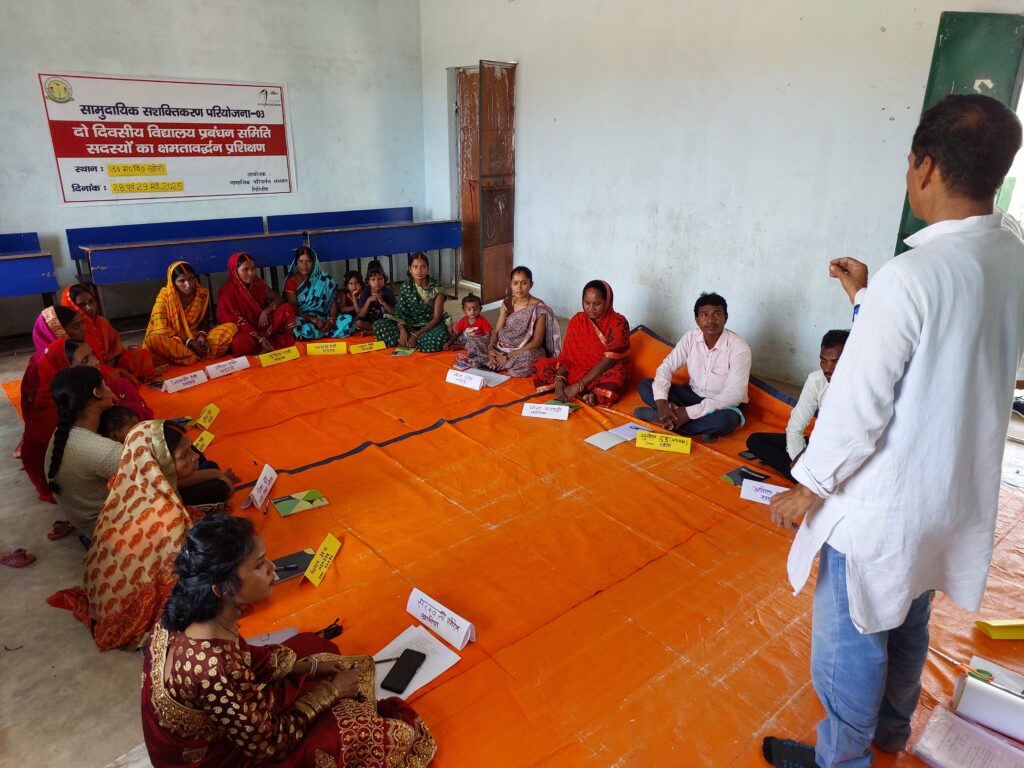
With support from the Responsible Mica Initiative and the European Union, Samajik Parivartan Sansthan (SPS) organized a two-day training on May 28–29, 2025, at Utkramit Madhya Vidyalaya, Khoro. Sixteen SMC members participated.
The training focused on:
- Understanding SMC roles and responsibilities
- Holding regular monthly meetings
- Strengthening collaboration with teachers
- Using structured tools to monitor school progress
Outcome and impact: from hesitation to leadership
The training led to visible improvements in Sunil’s leadership and SMC functioning:
- Sunil became more confident, engaged, and proactive in meetings.
- SMC members now participate openly and meet monthly.
- A structured monthly monitoring tool helps systematically track school activities.
- Teachers and the SMC now collaborate closely to implement a school development plan.
Sunil’s honesty, training exposure, and enthusiasm positioned him as a community role model, bridging gaps between the school and the SMC. The transformation demonstrates the long-term potential of empowering grassroots leadership to strengthen school governance.
Key takeaway: empowered leaders drive school improvement
Sunil reflects:
“I can think and speak now in a more organized way in our daily life. Here [in training] I learned how to introduce myself properly and speak thoughtfully as a chairperson.”
The experience highlights that capacity building for SMCs can lead to meaningful participation, stronger governance, and improved educational outcomes in rural communities.